Rescue Rush Review
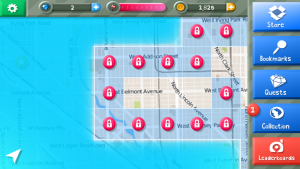
+ Universal App - Designed for iPhone and iPadRescue Rush turns actual street maps into one giant game of Pac-Man.
Read The Full Review »
Posts Tagged GeolocationRescue Rush Review+ Universal App - Designed for iPhone and iPadRescue Rush turns actual street maps into one giant game of Pac-Man. Read The Full Review » Evzdrop ReviewiPhone App - Designed for the iPhone, compatible with the iPadEvzdrop is an app that combines the best features of microblogging and check-in services. Read The Full Review » Saga ReviewiPhone App - Designed for the iPhone, compatible with the iPadSaga's a journey of geolocation and check-ins, but is it one worth taking? Read The Full Review »
Some social networking apps are designed to bring people from faraway lands together. Glancee can do that too, but it’s also designed to try and bring people nearby together, slaying that most heinous of demons once and for all: the awkwardness that comes from trying to meet other people. Users log in with Facebook, then start trying to find people with interests similar to them. Profiles are automatically filled out by Facebook information, including likes, which helps to cull together a list of other users that may be compatible based on shared interests. Matching attempts to base compatible interests on similar subjects, like sports teams, and not just scanning and saying “these two people like these exact same things on Facebook!” This does tend to fall apart at times, though – there are reasons why a fan of football player Michael Crabtree might not be compatible with a fan of the Texas Longhorns and Colt McCoy. Once a match is found, users can then chat with each other. The app finds people by proximity, and on the iPhone, it can use GPS in the background to help alert when compatible people are nearby, helping to break the ice. Glancee is available now as a free download.
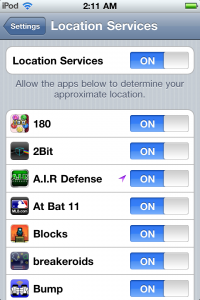
One of the big issues is that the iPhone is storing a large cache of data – according to Apple, this is not the actual user location, but a cache of the wifi/cell tower around you. The problem is that the cache isn’t getting cleared out, and this is a bug that Apple is claiming will be fixed in a future software update. This is in line with what John Gruber has said recently, that the length of the history of this cache is a glitch. Apple claims that they cannot track you with this data – that it is sent to them “in an anonymous and encrypted form” and that “Apple cannot identify the source of this data.” As well, this cache will no longer be backed up in iTunes, and that the file will be encrypted in the next major software update. Now, one of the other controversies is that this data was still being sent (approximately every 12 hours, according to research) even if Location Services were turned off. Apple is claiming that this too is a bug, and one that will be fixed in a software update in the near future. Now, skeptics may claim that this is old information, and Apple are only addressing it now as the controversy has risen up. Alex Levinson and Sean Morrissey published a book about this in December 2010, after all. However, consider that very few people actually knew about this until the recent controversy that flared up, and it seems plausible that Apple could be telling the truth, especially as Apple is now largely adjusted their behavior to similar to what Android does. As well, Apple has mentioned that they’re starting to collect traffic data in order to provide “iPhone users an improved traffic service in the next couple of years.” Along with Apple dumping Skyhook for location services last year, Apple has plenty of reason to be collecting location data. At worst, at least Apple is now fixing these issues since people have been complaining about them. Source: Engadget
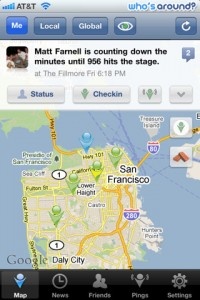
MeMap is an iOS app that is designed to try and connect all these people and services together, in a way. See, MeMap integrates with Facebook Places, considering that Facebook is one of the most used services on the internet, so you have a massive userbase there, and it will be valuable to a good number of users. When you load up the app and connect your Facebook account, you will get an interactive map that shows any geolocation data from your Facebook friends. Now, here’s where the connection of disparate networks comes in – if data is shared from a service like Foursquare, Gowalla, or Loopt, it is pinned to your MeMap map. Now, there’s obviously the thought that it actually isn’t integrating those other services, but this may be to the advantage of the service – it’s just far easier to support just a Facebook login, and doesn’t complicate the user experience. The ultimate idea behind MeMap, as according to the founder of MeMap, Matt Farnell, is to make something similar to Twitter, where it’s easy to just follow what your friends are doing. “We draw an analogy between our concept in the location sharing space, and the way that people have evolved to use Twitter. The current location sharing networks would be like limiting Twitter to the content creators, excluding anyone preferring to simply follow.” After all, that is the interesting thing about Twitter, and about geolocation services – it’s about targeting messages and sharing what you want to share to people who are interested in it. Twitter has made it easy, and MeMap is hoping to step into that space. Their app is available on the App Store right now for free.
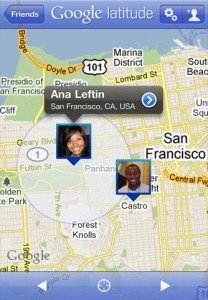
Seriously, if it’s free and will help you be much cooler than you already are, how can you go wrong? For all you fun seekers and SXSW attenders, this one is a no brainer. After a bit of a false start last week, Google has officially launched its Latitude app for the iPhone. The free app allows users to continuously broadcast their location to friends and family as well as see where other contacts are on a map at any time. The app also allows for background updating, allowing Latitude to continue to track where you are even when the app is closed.
It’s also worth noting that Latitude has been available to iOS users as a web application for quite a while now, but this is the first time it’s been presented as a native app. Thus, Google has built the app with the iPhone 4 in mind so users will need a device such as an iPhone 4 or 3GS which is running iOS 4 or above to support the service. If you’re still clinging to an original iPhone or iPod Touch then sorry, but it’s not going to work. The app will also work with the iPad, but considering it’s more of a mobile geolocating service it might not be terribly useful for tablet owners. In any event, Latitude is now officially here for iPhone users, so get out there and continue oversharing all the details of your life, including where you’re standing at any given second. FREE! ![]() iPhone App - Designed for the iPhone, compatible with the iPad Released: 2010-12-08 :: Category: Social Networking [via Google Mobile] |